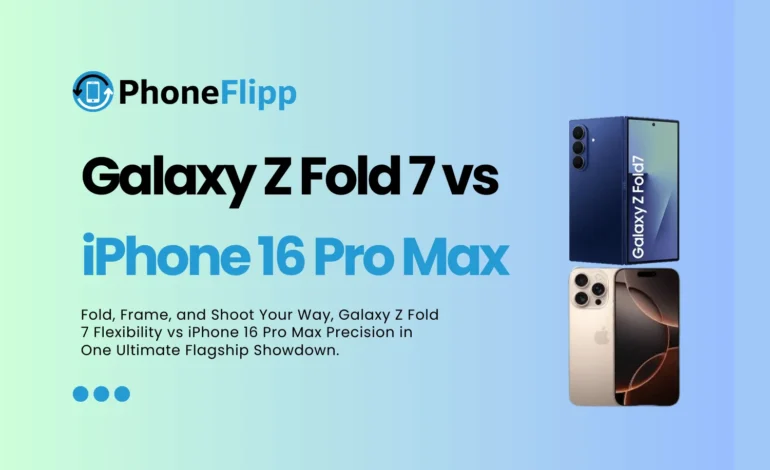
Samsung Galaxy Z Fold 7 vs iPhone 16 Pro Max

Samsung’s Galaxy Z Fold 7 and Apple’s iPhone 16 Pro Max represent two very different visions of what a flagship phone should be. One is a cutting‑edge foldable phone that turns into a small tablet; the other is a refined, ultra‑polished non-foldable phone that pushes camera, performance, and ecosystem integration.
This Galaxy Z Fold 7 vs iPhone 16 Pro Max guide looks in depth at specs comparison, camera shootout results, performance comparison, and real‑world usability and ergonomics, so you can decide which flagship suits you better.
1. Design Comparison: Foldable vs Non‑Foldable Phone
Form factor and ergonomics
- Samsung Galaxy Z Fold 7
- Foldable design with two displays: a tall, phone‑like cover screen and a large inner tablet‑style display.
- When folded, it’s narrower but thicker than a typical phone; when unfolded, it becomes an 8‑inch‑class mini tablet that excels at multitasking and media.
- This makes it a unique productivity device but slightly more awkward for one‑handed use and slim pockets.
- Apple iPhone 16 Pro Max
- Classic slab design with a single large display.
- Slim, relatively light (for its size), with a premium metal frame and glass front/back.
- Familiar ergonomics: easy to use one‑handed for some, but it’s still a big phone best handled with two hands for extended use.
Foldable vs non-foldable phone takeaway:
If you want your phone to double as a mini tablet with genuine foldable phone benefits (split‑screen, large canvas, S Pen support in Samsung’s world), the Galaxy Z Fold 7 is in a different class. If you prefer simpler, more robust hardware and a traditional feel, the iPhone 16 Pro Max fits better.
Durability and hinge design
- Galaxy Z Fold 7 durability and hinge design
- Uses an advanced hinge that’s thinner and lighter than earlier generations, with reinforced materials and improved dust/water resistance compared to older folds.
- Still includes a moving part and an inner plastic‑covered display, which, while substantially tougher than before, is inherently more fragile than a single rigid glass panel.
- Long‑term durability depends on careful handling—avoiding sharp objects on the inner screen and being mindful of debris at the hinge.
- iPhone 16 Pro Max durability
- Rigid body with a strong metal frame and tough front glass (Apple’s latest protective glass branding).
- Simple structure with no hinges or moving display parts, so fewer mechanical failure points.
- Excellent water and dust resistance ratings make it a strong everyday carry for rough use.
Durability verdict:
The Fold 7 is much tougher than early foldables but still can’t match the brute‑force robustness of the iPhone 16 Pro Max’s monolithic design. If you’re rough on phones, that matters.
2. Display Specs: Foldable Display vs Classic Flagship Panel
Main display comparison
- iPhone 16 Pro Max display specs
- ~6.7‑inch OLED with high resolution (around 2868 × 1320) and very high pixel density (~458 ppi).
- High refresh rate at 120 Hz with adaptive ProMotion for smooth scrolling and power savings.
- Very high peak brightness (over 2000 nits) for outdoor readability and HDR content.
- Excellent color accuracy and uniformity.
- Galaxy Z Fold 7 foldable display specs
- Around 7.6–8.0‑inch Dynamic AMOLED 2X inner display with resolution in the 2200 × 1968 range and ~367–370 ppi.
- 120 Hz adaptive refresh rate as well.
- Massive screen area makes it ideal for split‑screen apps, gaming, video, and document editing.
- There is still a crease where the display folds, though it’s less visible in use than in earlier Fold generations.
Display verdict:
For pure pixel density and “perfect” flatness, the iPhone 16 Pro Max wins. For immersion, multitasking, and productivity, the Galaxy Z Fold 7’s big foldable display is unmatched in this flagship phones comparison.
Cover display and daily usability
- Galaxy Z Fold 7 cover display
- ~6.5‑inch AMOLED cover screen at 2520 × 1080 resolution and 120 Hz.
- Fully usable as a normal phone for quick tasks, messaging, and calls without unfolding.
- Great when you don’t want to open the main display.
- iPhone 16 Pro Max
- Single main display, always “ready”; no need to unfold or change grip.
In practice, the Fold’s cover screen plus inner display give you more options but also a bit more complexity; the iPhone is straightforward.
3. Specs Comparison: Processor, RAM, Storage, and Connectivity
Processor / chipset comparison
- Apple iPhone 16 Pro Max
- A18 Pro (naming continuity), Apple’s latest flagship chip.
- Extremely strong single‑core and multi‑core performance, with particularly high efficiency and excellent GPU power.
- Optimized deeply across iOS, making the phone feel exceptionally smooth.
- Samsung Galaxy Z Fold 7
- Qualcomm Snapdragon flagship (often branded Snapdragon “for Galaxy” variant), custom‑tuned for Samsung.
- Top‑tier CPU and GPU performance, especially in multi‑tasking and gaming.
- Strong on‑device AI features and generative capabilities.
Performance comparison:
Both are true flagships. The iPhone 16 Pro Max generally edges out synthetic CPU and GPU benchmarks and benefits from ultra‑tight hardware‑software integration. The Fold 7 minorly trails in peak numbers but offers more screen space for true multitasking, which can be more impactful in day‑to‑day productivity.
Storage and RAM options
- iPhone 16 Pro Max
- Storage: 256 GB, 512 GB, and 1 TB; no microSD expansion.
- Uses NVMe storage for very high read/write speeds.
- RAM is generous by Apple’s standards, but lower in absolute GB compared to Android flagships, compensated by iOS optimization.
- Galaxy Z Fold 7
- Storage: 256 GB, 512 GB, 1 TB; no microSD here either.
- Uses UFS 4.0 storage—very fast, power efficient.
- Offers higher RAM counts to support multi‑window and heavy app usage.
Wireless connectivity and extras
Both devices include:
- 5G (sub‑6 and mmWave depending on region).
- Wi‑Fi 6E / Wi‑Fi 7‑class connectivity (depending on market).
- NFC, Bluetooth 5.x, ultra‑wideband (UWB) on higher trims.
The Fold 7 may also support stylus (S Pen) input on the inner display, which is a massive bonus for note‑takers and creators.
4. Battery Capacity, Charging, and Endurance
Battery capacity and charging
- iPhone 16 Pro Max
- Battery around 4685 mAh.
- Fast wired charging (mid‑20 W range) and fast wireless charging with MagSafe.
- Excellent efficiency thanks to the A18 Pro and iOS; among the best for battery longevity in large phones.
- Galaxy Z Fold 7
- 4400 mAh dual‑cell battery.
- 25 W wired fast charging, quick to reach 50% and full in a bit over an hour.
- Fast wireless charging plus reverse wireless charging (Wireless PowerShare) to charge earbuds or another phone.
Real-world endurance
The Fold’s large inner screen consumes more power when used heavily, so heavy multitaskers on the inner display may see lower screen‑on time than iPhone users doing similar tasks. With more typical usage mixing the cover display and inner panel, the Fold 7 still reaches “all‑day” endurance for many people.
Battery verdict:
iPhone 16 Pro Max is generally more efficient and can last longer on similar usage, especially in single‑screen scenarios. The Fold 7 is good—but drive the big screen hard and you’ll reach for the charger sooner.
5. Camera Phone Comparison: Hardware and Imaging Approach
Main sensor comparison and lens lineup
Both are serious camera phones with slightly different philosophies.
- iPhone 16 Pro Max camera performance
- Triple rear camera system:
- ~48 MP wide main camera.
- ~48 MP ultra‑wide camera.
- 12 MP telephoto with 5× optical zoom.
- 12 MP front camera with advanced depth sensing.
- Emphasis on consistent color, natural tones, and rock‑solid video.
- Triple rear camera system:
- Galaxy Z Fold 7 camera review (hardware)
- Rear triple system:
- 200 MP wide main camera.
- 12 MP ultra‑wide camera.
- 10 MP telephoto with 3× optical zoom.
- 10 MP cover camera, plus an under‑display camera on the inner screen (for video calls/work, less for serious photography).
- Emphasis on headline resolution, AI‑boosted detail, and versatile framing options.
- Rear triple system:
Main sensor comparison:
The Fold 7’s 200 MP sensor lets Samsung bin pixels aggressively for low‑light and detail. The iPhone’s 48 MP sensor, paired with Apple’s processing, focuses more on tonal fidelity and predictable image quality than sheer pixel count.
Ultra-wide camera and portrait mode
- Ultra-wide camera
- Fold 7: 12 MP ultra‑wide; good detail, strong dynamic range, slightly more saturated color.
- iPhone 16 Pro Max: high‑quality ultra‑wide with coherent color matching and very good edge performance.
- Portrait mode
- Both offer portrait modes with adjustable blur and different focal lengths.
- The iPhone excels at skin tones, background blur realism, and separation.
- The Fold 7 uses high‑resolution data plus Samsung’s AI to produce punchy portraits with strong subject pop.
6. Camera Shootout: Photo Quality Comparison in Real Use
Daylight image quality
In camera performance tests and camera shootouts:
- Galaxy Z Fold 7
- Produces sharp, vibrant images with punchy contrast.
- Colors lean toward saturated; skies and foliage pop.
- The 200 MP sensor gives exceptionally detailed captures if you zoom or crop.
- iPhone 16 Pro Max
- Aims for natural, accurate color and reliable white balance.
- Great highlight control and midtone handling; overall “cinematic” look.
- Less showy but more consistent and easier to grade for serious editing.
Photo quality comparison:
If you love vivid, standout photos for social sharing with no editing, Fold 7 often looks more dramatic out of the box. If you value accurate colors and a “camera‑like” baseline, iPhone 16 Pro Max has an edge.
Low-light photography and night mode
In low-light photography and night mode tests:
- Galaxy Z Fold 7 low-light photography
- The large 200 MP sensor, pixel binning, and Samsung’s Night mode combine for bright, detailed low‑light shots.
- Sometimes scenes can look brighter than reality, with visible noise smoothing.
- iPhone 16 Pro Max
- Excellent Night mode with well‑balanced exposure, contrast, and color.
- A bit more conservative on brightness, but very clean noise profile and stable color.
Low‑light verdict:
In a “Galaxy Z Fold 7 low-light photography vs iPhone 16 Pro Max” comparison, the Fold 7 often delivers brighter, more detailed shots while the iPhone prefers a realistic scene look with very refined noise control.
Zoom performance
- Fold 7 zoom performance
- 3× optical telephoto, plus high‑resolution main sensor used for digital/hybrid zoom beyond that.
- Excellent detail up to moderate telephoto ranges; AI uses that 200 MP sensor smartly.
- iPhone 16 Pro Max zoom performance
- 5× optical telephoto provides clean long‑range zoom.
- Excellent stabilization and consistent color across zoom levels.
Zoom verdict:
At short telephoto, Fold 7 can look excellent due to AI and pixel binning; at longer ranges, the iPhone’s 5× optics and stabilization often win for clean, usable images.
7. Video Recording: Capabilities and Quality
Video recording specs
- iPhone 16 Pro Max
- 4K up to 120 fps and 1080p up to 240 fps.
- Supports HDR, Dolby Vision, ProRes, and advanced cinematic video modes.
- Among the best for mobile filmmaking and vlogging.
- Galaxy Z Fold 7
- 8K video at 30 fps, 4K at 60 fps, 1080p at 240 fps.
- HDR video support and advanced AI noise reduction and stabilization.
- Inner and outer cameras give flexible framing options.
Video quality and stabilization
- iPhone 16 Pro Max
- Industry-leading video image quality: accurate color, great dynamic range, and exceptional image stabilization.
- Advanced tools (cinematic mode, ProRes, log profiles) make it ideal for creators.
- Galaxy Z Fold 7
- Very good video quality, especially in 4K; 8K is more of a spec‑showcase but useful for some.
- Stabilization is strong, though the iPhone tends to look smoother and more natural, especially when walking or panning.
For “best flagship camera phones comparison” in video, the iPhone 16 Pro Max remains the safer pick if video is your top priority.
8. Software Features, Ecosystem, and User Experience
Software features and UI
- Galaxy Z Fold 7 software features
- One UI with foldable‑specific enhancements:
- Multi‑window and split‑screen multitasking.
- App continuity between cover display and main display.
- Flex Mode for partial folding, turning the device into its own stand.
- Great for document work, spreadsheets, note‑taking with S Pen, and side‑by‑side apps.
- One UI with foldable‑specific enhancements:
- iPhone 16 Pro Max user experience
- iOS with refined gestures, consistent app behavior, and widespread developer optimization.
- Simpler, more streamlined interface.
- Excellent long‑term update support and stability.
Ecosystem features
- Samsung / Android ecosystem
- Tight integration with Galaxy tablets, watches, TVs, Windows PCs (via Link to Windows), and cloud services.
- More flexible default apps, file system access, and customization.
- Apple ecosystem
- Seamless continuity across iPhone, iPad, Mac, Apple Watch, AirPods, and Apple TV.
- AirDrop, Handoff, Universal Clipboard, iCloud Photos, and more.
- Particularly compelling if you already own other Apple devices.
Ecosystem verdict:
If you live in Apple’s world, the iPhone 16 Pro Max multiplies what you already have. If you want maximum phone‑as‑PC flexibility and cross‑platform Android freedom, the Fold 7 plus Samsung’s ecosystem is extremely powerful.
9. Price Comparison and Value for Money
Price and configurations
Pricing depends on region and promotions, but broad patterns:
- Both are premium tier and expensive at launch.
- Higher storage tiers (512 GB, 1 TB) raise prices sharply.
- The Fold 7 usually costs more than standard slab flagships due to its complex foldable hardware.
Value for money
- Galaxy Z Fold 7 value for money
- You pay for cutting‑edge hardware and dual‑display versatility.
- Exceptional value if you will really use the foldable display for productivity, media, and multitasking.
- iPhone 16 Pro Max value for money
- You pay for peak performance, camera/video excellence, and long‑term software support.
- Strong resale value typically softens the effective long‑term cost.
If you just want “a great phone,” the iPhone 16 Pro Max often feels like better value because you’re not paying a foldable premium. If you want “phone + tablet in one device,” the Fold 7 can justify its price.
10. Which Flagship Should You Choose?
Framing it around the long‑tail questions:
- “Samsung Galaxy Z Fold 7 vs iPhone 16 Pro Max camera shootout”
- Photos: Fold 7 often more vivid and detailed, especially in bright light and some low‑light cases; iPhone more natural and consistent.
- Video: iPhone 16 Pro Max remains the benchmark for most creators.
- “Galaxy Z Fold 7 low-light photography vs iPhone 16 Pro Max”
- Fold 7: brighter, more dramatic low‑light.
- iPhone: balanced, realistic low‑light with excellent noise handling.
- “Galaxy Z Fold 7 specs vs iPhone 16 Pro Max detailed comparison”
- Fold 7: foldable dual displays, 200 MP main camera, 3× telephoto, 4400 mAh battery, 25 W charging, high RAM, UFS 4.0 storage.
- iPhone 16 Pro Max: 6.7″ single panel, 48 MP main, 5× telephoto, 4685 mAh battery, top‑tier efficiency, NVMe storage, and class‑leading video.
Choose the Galaxy Z Fold 7 if:
- You want the most advanced foldable phone with genuine productivity benefits.
- You value a large inner display for multitasking, media, and S Pen.
- You like punchy photos, flexible camera setups, and cutting‑edge design.
Choose the iPhone 16 Pro Max if:
- You want the most polished, reliable non‑foldable flagship with top‑tier video and photo consistency.
- You’re invested in the Apple ecosystem and care about long OS support.
- You prefer durability, simplicity, and best‑in‑class video capture over foldable experimentation.
Both are among the best flagship camera phones of their generation; your decision comes down less to raw performance and more to which form factor, ecosystem, and imaging philosophy fits your life.